


JB.COM Fairness India: Transparent Results for Crypto Casino Rounds
Fairness is one of those things players tend to take on trust—until they have a way to actually check it. This page looks at how JB.COM approaches result verification, what mechanisms sit behind a casino round, and why transparency plays a part in how much a player can rely on the outcome of a bet.
For players using the JB.COM app, verifiable fairness means that the process behind a result can be checked. It does not change the nature of the games themselves or mean that a round is designed to favour any particular outcome.
Result Proof Before and After a Casino Round
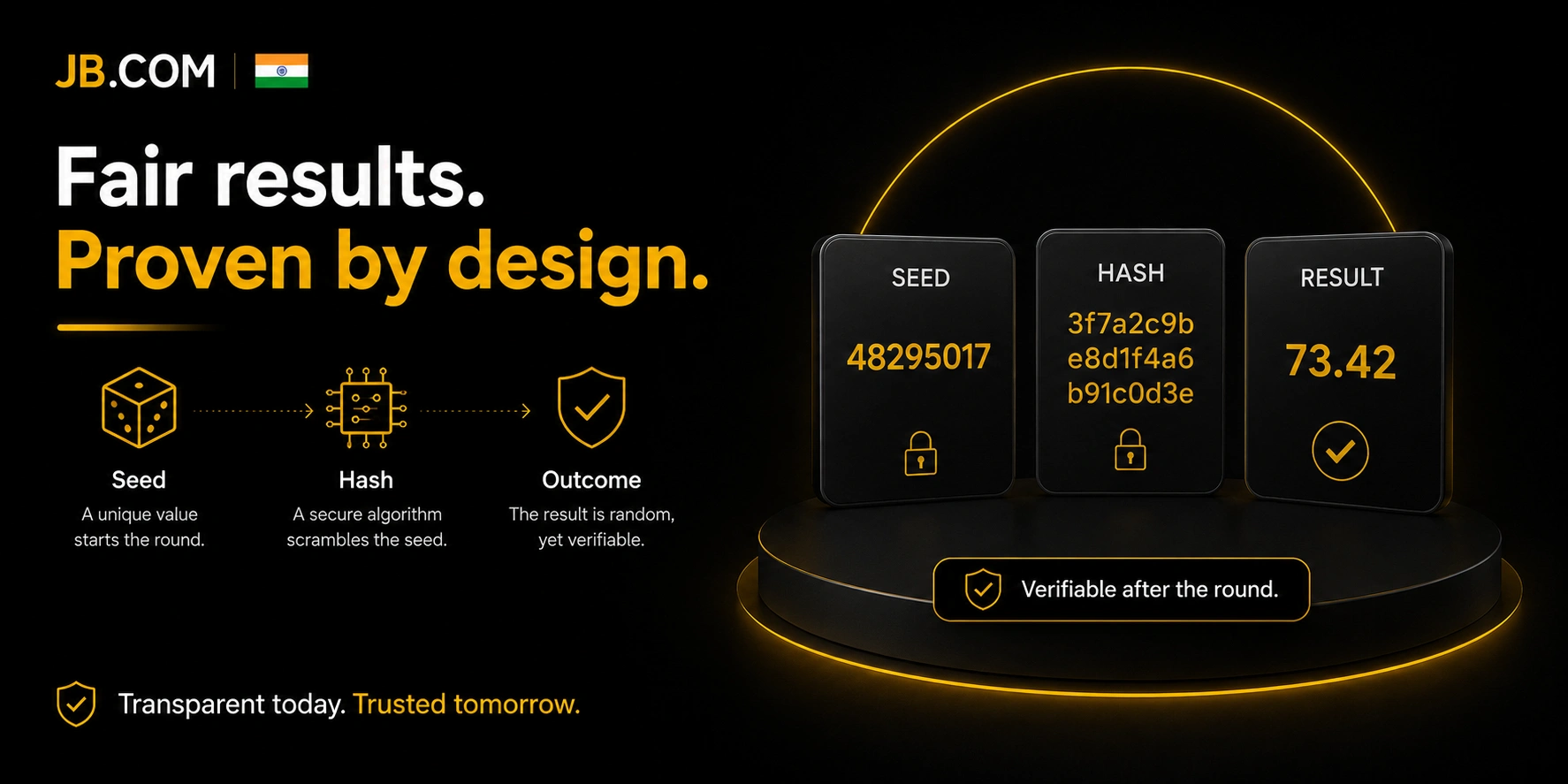
Before a round starts, certain values are already locked in behind the scenes, even though the player doesn’t see the final outcome yet. Once the round finishes, those same values can be checked against the result that was shown, confirming that nothing was altered in between the start and the finish of the round.
Put simply, a player doesn’t need to understand the technical process to benefit from it – the point is that the outcome can be traced back and confirmed, rather than taken purely on faith.
JB.COM Seed Checks, Hash Logic and Round Verification
Behind each round, a starting value (often called a seed) is combined with a scrambling method (a hash) to produce a result that can’t be predicted in advance but can be verified afterward. This is what allows a round’s outcome to be checked without needing to reveal anything before the game is played.
Without getting into the mathematics, the basic idea is this: the values used to generate a result are fixed before the round starts, and revealed afterward so the process can be independently confirmed rather than just assumed.
India Player View of Randomness in Fast Games
Fast-paced casino formats, common among many players in India, depend heavily on randomness happening correctly round after round. Because these formats move quickly, players may not always pause to think about how the result was generated – but the same verification principles apply whether a round takes ten seconds or two minutes.
It’s worth being clear about one thing: verifiable randomness confirms that a result wasn’t tampered with – it says nothing about whether the next round will be a win or a loss. Fair mechanics and favourable outcomes are two separate ideas.
Audited Number Generation for Casino Style Results
The system responsible for producing casino-style outcomes is checked through independent auditing processes, rather than relying solely on internal claims. This kind of review looks at whether the number generation behind results behaves the way it’s supposed to – consistently and without patterns that could be predicted or exploited.
This auditing sits underneath the games players interact with directly, whether that’s a round of a casino-style title or a fast-format bet. It’s a background layer, not something a player needs to manage themselves.
Risk Awareness When Fair Games Still Remain Chance Based
Even with verifiable fairness in place, every round remains a chance-based outcome. A transparent process doesn’t reduce risk – it simply confirms that the risk wasn’t manipulated. Wins and losses stay part of how these games work by design.
Because of this, responsible play matters regardless of how fair the underlying system is. Setting a budget in advance, staying within it, taking breaks when needed, and remembering the 18+ age requirement are all part of playing in a way that keeps the experience manageable. Fairness confirms the process; it doesn’t remove the responsibility that comes with real-money play.
FAQ
No, fairness only confirms the process behind a result wasn’t altered – it doesn’t affect whether an individual round wins or loses.
In many cases, the values used to generate a result can be reviewed after the round, though the exact method depends on the specific game.
Speed doesn’t change the verification process – it’s the same underlying mechanism, just applied to a quicker round.
Independent auditing is generally part of the process, reviewing the number generation systems rather than relying only on internal checks.
No, chance-based outcomes remain part of every round regardless of how the fairness process works, so responsible play still applies.